The flat that taught us to stop asking.
How six people, one tired calendar, and a WhatsApp bot that Meta switched off turned into the app we live with every day.
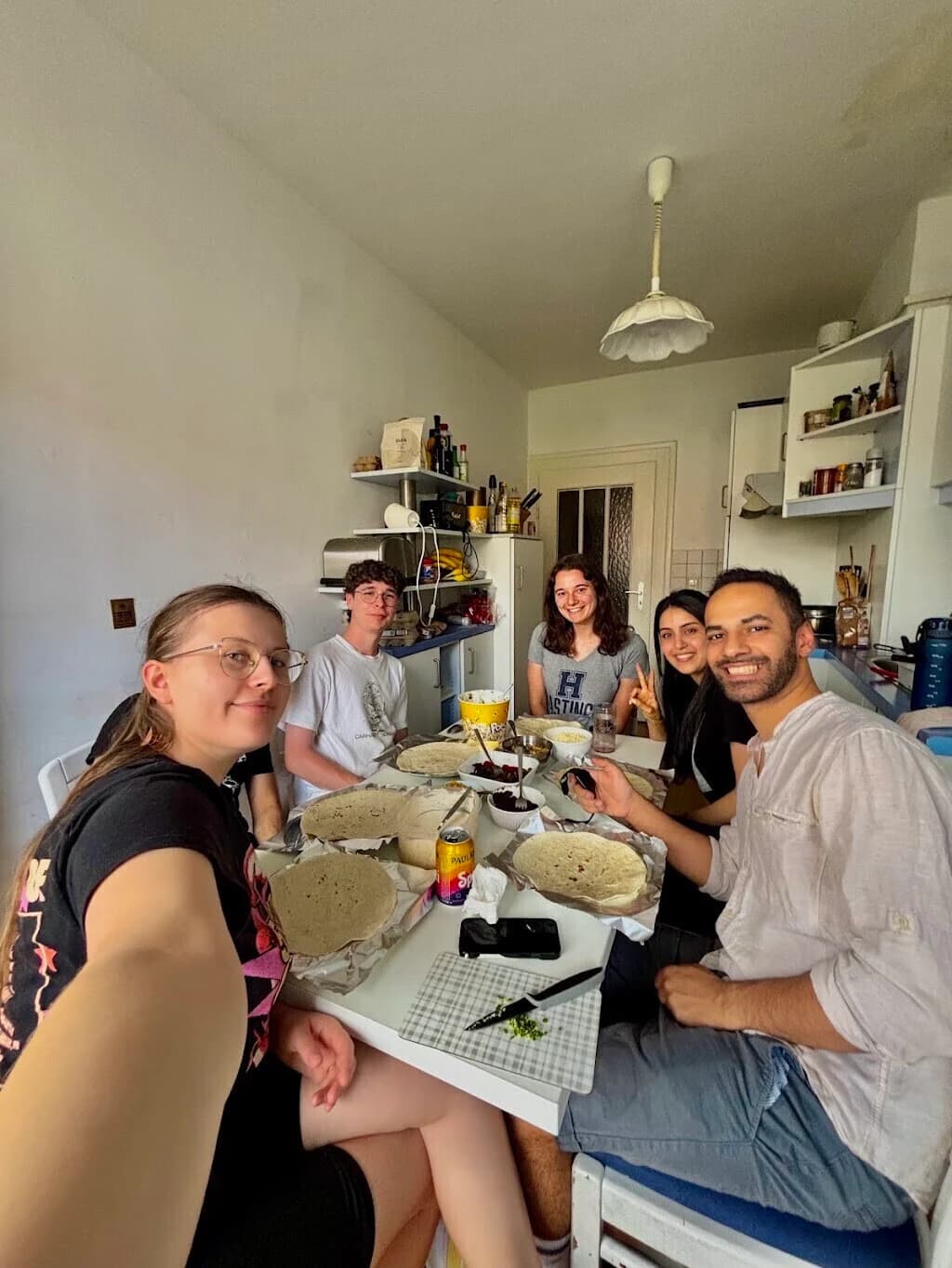
I have lived in the same WG in Weiden since 2023. Six of us, one kitchen, one bathroom, and the small daily arithmetic of who does what. For a long time the most stressful object in the flat was not the dishwasher or the bin. It was a question. Whose turn is it?
We are not a chaotic household. We like each other. We wanted the same simple thing every WG wants: chores done, money squared, plans made, without anyone having to become the person who chases everyone else. So we did the obvious thing. We pinned a calendar to the kitchen wall.
And honestly, for a few weeks it was lovely. There is something nice about a shared plan you can point at. Then real life arrived, the way it always does. Someone went on holiday. Someone had an exam week. Someone simply forgot. The calendar did not know about any of it, so it kept insisting on a version of the week that was no longer true, and the chasing began. A polite message here, a slightly less polite one there.
We tried the apps. They lasted about a month.
If a wall calendar was too dumb, an app would be smarter. That was the theory. We moved to Flatastic, and for a few weeks it was genuinely good. Tasks had owners. Things got ticked off. Then our lives shifted again, the way lives do, and the fixed rotations could not bend with us. Mark someone away and the rota did not really care. The app expected our week to stay tidy, and our week never does.
That was the lesson that stuck. The problem was never finding an app. It was that every app asked our lives to behave, instead of behaving around our lives.
So I started asking a different question, the kind you mutter while drying a pan that someone else was supposed to dry. What if the home just did it? Not an app you open and manage and tend to like a little garden, but something that quietly sets up the chores, keeps the house in a fair rotation, knows who is actually around, and balances the load on its own.
I built a bot to see if the idea was real.
Before building anything serious, I wanted to know if the feeling was true. So I made a WhatsApp bot. It was powered by a GPT model and a backend that understood our house: who lived here, what needed doing, how often, and who was around. Every day it would message a flatmate about their task, in plain language, and you could just answer like a person. Done. Later. I am away this week. No app, no buttons, just a chat.
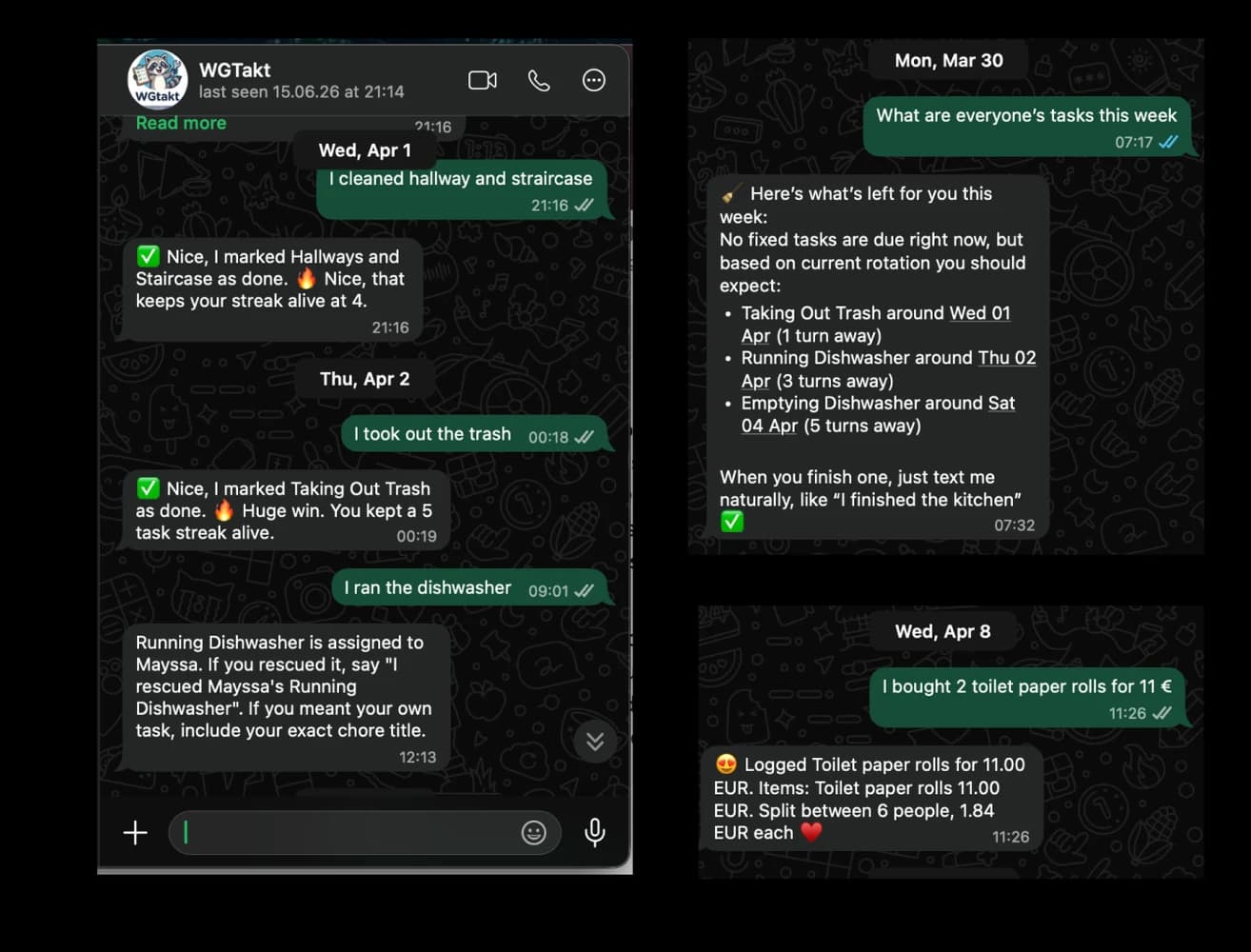
It worked better than I expected. The flat felt calmer. Nobody was the nag, because the nagging had quietly moved to something that never got tired or resentful. And then one morning, the bot went quiet. Meta gates WhatsApp bots behind an approval process built for companies with thousands of users, not for a flat in Weiden testing an idea. The bot was finished. But the idea, clearly, was very much alive.
So Maria and I built the real thing.
Maria is my partner, and somewhere between the bot dying and us refusing to let the idea die with it, this became a student project we were building together. We sketched screens on paper, worked between classes and over dinner, and slowly turned everything the bot had taught us into a proper app: something with a face you actually want to look at, and a patient system underneath.
Two ideas came out of living here that I had not seen anywhere else. The first we call rolling chores. Taking out the trash does not run on a calendar, it runs on how full the bin is, which depends on how many people are home. So instead of forcing it onto a fixed schedule, the next person is only assigned once the last one finishes. When two flatmates are away, the bin fills slower, and the duty quietly spaces itself out. Nobody changes a setting. The house just notices.
The second we call linked chains. Some chores hand off to each other, but on different clocks. Run the dishwasher, and a few hours later someone should empty it, but it should not need running again for a day. So you can chain one task to the next with whatever delay makes sense, looping forever or running once. It is a small idea borrowed from programming, and it turns out to fit a kitchen perfectly. Laundry works the same way.
We stopped asking whose turn it was. The flat just knew.
There is a lot more in there now. Shared costs that settle without the awkward spreadsheet. Notifications you can answer from the lock screen, the same way you answered the bot. Events, because some of the best evenings here started as a barbecue nobody quite organised. But all of it comes back to that one feeling from the kitchen wall: a home should hold the work, not one person.
The six of us who started all this.
We still live together in Weiden, and we still test every change at the same kitchen table. These are the people behind WGTakt.
- VarunStudent builder
- MariaStudent co-builder
- MayssaWG tester
- NoahWG tester
- JuliaWG tester
- DuruWG tester
We still test every change at the same table, after dinner, with the same six people who started all of this. If something annoys us, it gets fixed before it reaches you. That is the whole promise, really.
Varunfor Maria, Mayssa, Noah, Julia, Duru, and our WGThat is our story. We would love to hear yours.
If your flat has its own version of the calendar on the wall, we built WGTakt for you. It is free during preview.
More stories from real WGs are coming soon.